
The Question Mark
The answer that isn't an answer

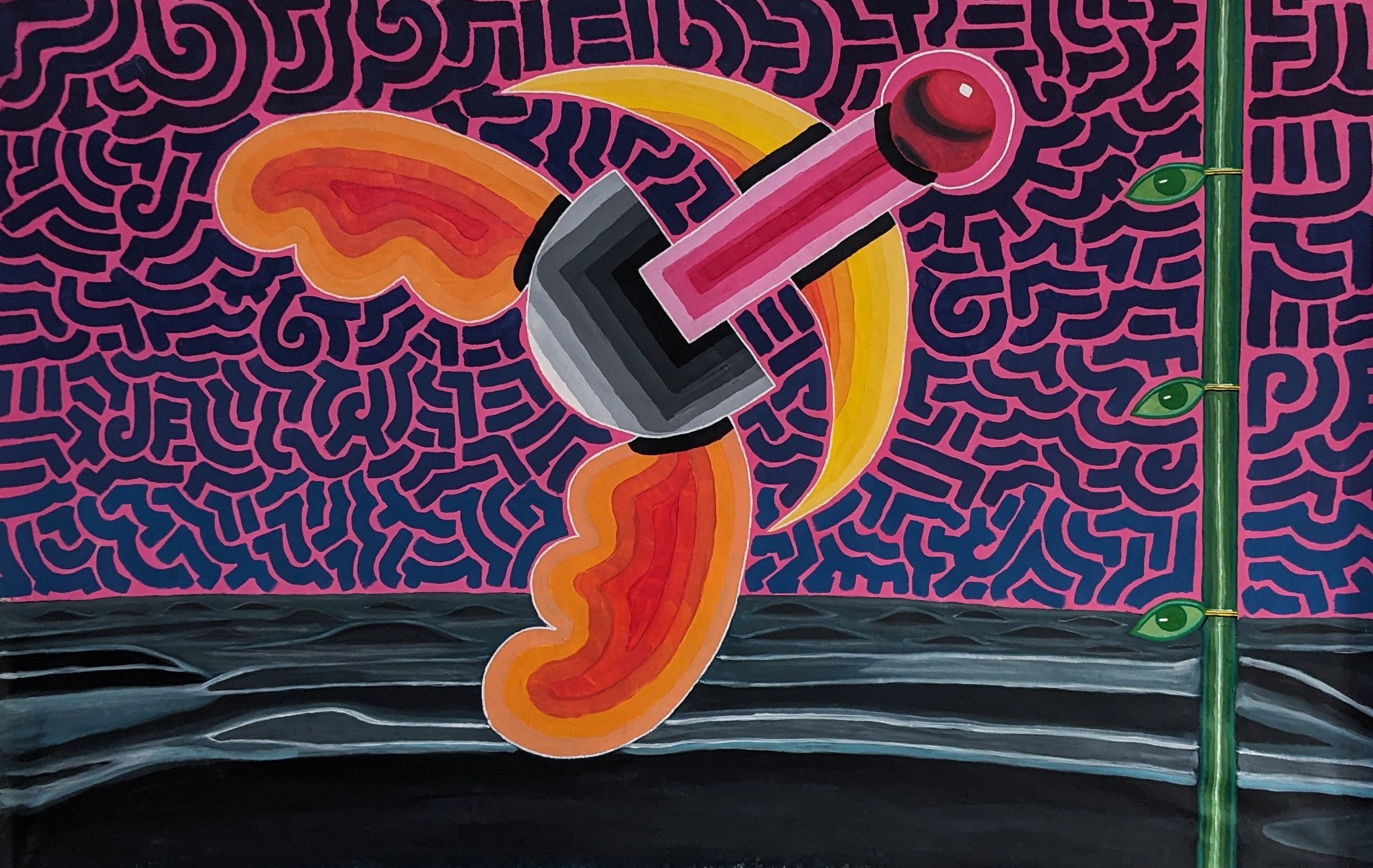
Everyone has their version of how things are. Inquiry and contemplation begin with questioning one’s own version of how things are. As you question your version, you’ll keep encountering and clinging to new versions.
That’s how the mind operates — always reaching for certainty. Someone on the screen or the page says, “Hey, look, that’s how things are.” And if there’s some resonance, you’ll begin considering that. Maybe that is how things are? you wonder while stroking your long, grey chin beard.
No matter how appealing and convincing that last version was, there comes a time when it feels stale, off, inaccurate. It always does. If you’re perceptive, you’ll notice that trap — reaching for another version of reality in the hopes it might be true. Even if you’re not perceptive, with time, it will be glaringly obvious.
You’ll be disappointed by conceptual houses of cards often enough so that they lose their appeal. They may still appeal in that they offer a certain kind of intellectual amusement, but no longer in an all my questions will be answered way.
Your mind is looking for an invincible model of reality, something solid to lean on. Fortunately, every time you lean on something, you fall right through.
So you seriously consider that existential questions aren’t answered with words alone. Many intelligent and poetic things have been said, and if the wisest words among them haven’t quenched your thirst, you’re lucky.
The answer you’re looking for might not be in a form you’re used to. It might not have a specific form at all. It might be an answer that is unlike any other answer you’ve ever received. It might be so simple that mind — the complexity machine — cannot take hold of it. It might be so obvious that you’ve never even considered it (an answer to anything). It might be so indisputable that arguing about it seems utterly ridiculous.
But where can you look for an answer when words by others are out of the question? When even your own words don’t measure up?
The first place you might look after trying words is senses. You begin to watch, to listen, to feel. You don’t get final answers, but you do notice things you haven’t noticed before: there’s more to sense experience than you knew — more range, more depth, more nuance, more intimacy. You might also notice that most of the things the mind panics about are only sensations, feelings, energy. When that receives some attention, the chatter moves into the background.
It dawns on you that you never had to figure out the narrative; you only had to be here for what arises as it arises. And this is much simpler than trying to find a satisfying ending to the story that never ends.

In Meša Selimović’s Death and the Dervish, the protagonist and narrator, Ahmed Nurudin, navigates a corrupt bureaucratic system and his own inner conflict in the hopes of freeing his brother, who had been imprisoned for an undefined crime. The twist arrives when he learns that not only has his brother been executed, but he had been dead while Ahmed was still trying to figure out what he did and how to free him.
The system is indifferent. The efforts are in vain. We’re Ahmed — trying to liberate a corpse accused of a vague misdeed, trying to get answers to questions based on false assumptions, answers that don’t satisfy because they’re about someone who’s not alive.
“Something collapsed — there, where I had been and here, where I was supposed to be, it was washing away like a sandy bank when the water rises, and I do not know how I managed to float to the surface, or why.”
— Death and the Dervish, Meša Selimović
But it’s hard to stay out of the mind. It’s hard not to be caught up in the endless loops of interpretation, explanation, justification, meaning, and needing to know. It’s hard not to believe the weirdo who has cosplayed as you all this time and who always seems to know what went wrong and what will go wrong. Until it’s no longer hard.
It’s also the weirdo’s voice claiming knowledge of reality and asserting that you haven’t got it yet. The same voice that can only create representations of reality is also the voice declaring it knows what must happen for you to wake up to reality. It’s like having your own personal bully who pushes you around all the time, and who also hates bullies and tells you to stand up to them, then gives you a wedgie, and adds that you shouldn’t even try standing up to him.
So you’re playing a rigged game with yourself. And part of the riggedness is believing that there’s some absolute reality to wake up to, which you can, of course, only wake up to if you’ve fulfilled a specific set of ideals — perhaps a magical experience, perhaps no thoughts, perhaps positive emotions only, perhaps a halo circling your scalp.
Whatever you think needs to happen first before you can have your concluding answer is never what needs to happen first. If anything, the only thing that needs to happen is putting aside the idea of a concluding answer, and that something needs to happen at all. Something might happen, or it might not, but thinking in these terms is just a way of thinking. Comparing your experience with someone’s description of their experience won’t do.
This brings us back to where to look for answers to existential questions, such as Who am I? or What the fuck? Where else would you look but in your own direct experience? What else is there?
Existential questions are always answered experientially, and no one can answer them for you. The irony is that the answer is eternally just standing there, out in the open, for anyone who cares to take a look.
It would be foolish of me to tell you how such an answer might reveal itself, which is exactly why I’m going to tell you:
The question stops making sense. Every question necessarily contains an error, and when that is recognized, everything before the question mark is deleted. A question mark indicates openness, uncertainty, freedom; seeing without concluding.
The question mark is an imperfect symbol for the answer. The answer is right there, in the whiteness of the wall in front of you, and it’s rustling in the tree outside your window, and it’s definitely in the oven right now, baking to perfection. What more can one say about it? Once the answer is apparent, the question no longer needs to be asked. After learning that 1 + 1 = 2, how often have you had to ask yourself what’s 1 + 1?
If you’re convinced you’re not seeing it, then it’s not because you’re not seeing it, but because you’re insisting on the belief that you’re not seeing it.
?
If you enjoy my work and want to show your appreciation, consider becoming a paid subscriber. Alternatively, you can show your support with a one-time tip or get some artwork on my Ko-Fi page.
This essay describes the origins of the inevitable double-minded confusion when identifies with the body-mind-complex.
http://beezone.com/latest/mirrorandcheckerboard.html
Ramani Maharshi once pointed out that we only have two choices - to identify with the mortal body-mind-complex or not. Pointing out that once having (thus) identified with the mortal body-mind-complex everything that you do is a dramatization of your unconscious karmic patterning.
A related reference:
http://beezone.com/latest/death_message.html Death as the Constant Message of Life
I am perpetually questioning the "reality" of anything so I understand what you mean. However, even if I know that my perception of reality is on shaky ground, I kind of need it as a tool. I know I will never get to the absolute truth about what reality is, but without some certainty, though manufactured I'm paralyzed. I have to do something after all. Here's an example: I just applied for a job in a program where I have been working for 10 years. From my point of view (and my supervisor), it made sense for me to get the job. I have a lot of experience in the program, and people say they love my work, but there was a bit added to the job that I would have to learn. I was told that it would be 30% of the job. I figured out that it wouldn't be difficult to learn. I have learned programs and technology in the past. But, the other person whose judgment matters decided that I didn't have the technical background to do the 30% of the job so I didn't get it. I kind of knew they wouldn't hire me for the position, but I worked hard at getting it and actually had gotten to the point of believing that I would be the best candidate.
So, the reality could be that I don't know how to present myself; they knew they weren't going to hire me for that job because I hadn't done that, specific, technical thing before even though it would be easy to learn; they don't value the work I do now in spite of the great reviews I get; they don't think much of me; they aren't very smart; I "shouldn't" be applying for this job anyway because I should be an entrepreneur; etc. I settled on "I should be an entrepreneur." Even if this is not the reality, it helps make sense of this difficult situation and gives me a direction to go in.